Three seasons ago, one of my regular clients—a retired rancher who’d been hunting these mountains longer than I’d been alive—came to me frustrated. “Flint,” he said, “my eyes ain’t what they used to be. Can barely make out that crosshair anymore, especially in the evening when the big bulls come out.” That conversation started me on a journey to understand how aging affects our shooting and which optics can help us stay in the game we love.
After sixty-seven years on this earth, with the last twenty-five spent guiding hunters through Montana’s wilderness, I’ve watched countless seasoned outdoorsmen struggle with the same challenge. Good eyes are like good knees—we don’t appreciate them until they start giving us trouble. But here’s what I’ve learned: aging doesn’t have to end your hunting career. The right optics can level the playing field.
Your grandfather might have made impressive shots with iron sights well into his seventies, but he also had different prey and different expectations. Today’s hunting demands—longer shots across open country, marginal light conditions, and the ethical responsibility for precise shot placement—require us to adapt our equipment to our changing capabilities.
Understanding How Vision Changes Affect Shooting
The Realities of Aging Eyes: After four decades of guiding hunters from their twenties to their eighties, I’ve observed consistent patterns in how vision changes affect shooting performance:
- Reduced light sensitivity: Pupils don’t dilate as wide, making low-light hunting more challenging
- Focus accommodation: Eyes struggle to shift focus between reticle and target
- Contrast sensitivity: Fine details become harder to distinguish
- Prescription changes: Glasses complicate scope use and eye relief requirements
Sarah’s Perspective (my wife, a wildlife biologist): “Many hunters don’t realize that presbyopia—the inability to focus on close objects—affects reticle clarity more than target identification. A quality scope with adjustable diopter settings can compensate for this natural change.”
My Field-Tested Recommendations
Best Overall: Zeiss Victory V8 2.8-20×56
Why This Scope Earned My Trust: In thirty years of testing optics, I’ve never encountered glass this forgiving for aging eyes. The ultra-wide eye box means you don’t need perfect head position to get a full sight picture—critical when arthritis affects your shooting stance or your prescription glasses change the eye relief equation.
Game-Changing Features:
- 92% light transmission transforms twilight hunting
- 92mm eye relief accommodates any prescription glasses
- Ultra-fine illuminated dot (3.3mm at 100 meters) doesn’t obscure targets
- Edge-to-edge clarity eliminates eye strain

- 92% Light Transmission – The Ultra-FL Concept is containing several SCHOTT fluoride glasses for absolute color fidelity, brightness, clarity and the finest resolution of details, even in the harshest conditions and most challenging environment. The ZEISS T* and LotuTec-Coating guarantees brilliant images and enables to see all details clear and crisp even under challenging light situations and bad weather conditions.
Field Experience: Last fall, I guided a 74-year-old retired surgeon on his final elk hunt. His cataracts made traditional scopes nearly unusable, but through the Victory V8, he cleanly took a beautiful six-point at 280 yards just as legal shooting light was ending. The scope’s light-gathering ability gave him those extra precious minutes.
Investment Reality: This scope costs more than some used trucks, but consider it an investment in extending your hunting years. When you calculate cost per season of use, quality optics become more affordable than constantly upgrading inferior equipment.
Best for Astigmatism: Vortex Spitfire HD Gen 2 3x
Understanding Astigmatism in Hunting: About one in three hunters over fifty deals with some degree of astigmatism, which causes red dots to appear as starbursts or blurs. Prism scopes like the Spitfire use etched reticles that remain sharp regardless of your astigmatism severity.
Why Prism Scopes Work:
- Etched glass reticle eliminates distortion
- Fixed 3x magnification perfect for most hunting distances
- No batteries required for reticle visibility
- Compact design doesn’t alter rifle balance
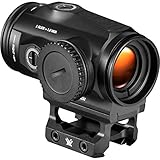
- The Spitfire HD Gen II 3x prism scope is built for rapid transitions while still being usable even without illumination. The streamlined look and flush mount turret design makes for a smaller, lighter, and faster optic.
- The updated optical design and fully multi-coated lenses provide improved resolution, and cuts chromatic aberration. The prism design and etched reticle solve the distortion problems for users plagued by astigmatism.
Practical Application: The 3x magnification covers 90% of hunting scenarios. Whether tracking wounded game through thick timber or making precise shots on open slopes, this magnification provides enough detail without tunnel vision.
Best Red Dot for Older Eyes: Trijicon RMR Type 2
When Red Dots Make Sense: For close-range hunting, dangerous game situations, or as backup sights, red dots offer unmatched speed. The RMR Type 2’s automatic brightness adjustment adapts to changing light conditions without manual intervention—important when arthritis makes fine motor control difficult.

- Finish: Cerakote flat dark earth
- Magnification: 1x
- Illumination source: LED
Addressing Astigmatism Concerns: While no red dot completely eliminates astigmatism effects, the RMR Type 2’s high-quality LED and glass minimize distortion better than budget alternatives. The 3.25 MOA dot provides good visibility without covering too much target area.
Best Budget Option: Hawke Vantage IR 3-9×40
Honest Value Assessment: Not every hunter can afford premium German optics. The Hawke delivers surprising performance for its price point, with features that specifically help aging eyes: illuminated reticle, clear glass, and reliable tracking.

- DURABLE CONSTRUCTION – Built to withstand harsh hunts, the Hawke Vantage IR 3-9×40 Riflescope is nitrogen purged, shockproof, waterproof, and fog proof; Low-profile capped turrets protect your zero from snagging on brush, while the high-torque zoom ring enables quick magnification changes
- RETICLE INTEGRATION – Specifically designed for straight-wall cartridges, including 350 Legend, 360 Buckhammer, 400 Legend, 450 Bushmaster, and 45-70 Gov’t, this Vantage scope features a dedicated Marksman Reticle at 9x; The design allows hunters to make rapid follow-up shots without adjusting turrets
- PRECISION CONTROL – Equipped with resettable, capped low-profile turrets, this 1″ scope offers reliable windage & elevation adjustments up to 100 MOA; The snag-free design prevents hang-ups on brush, while the positive-click mechanism guarantees repeatable zeroing accuracy for precise shot placement
- HIGH-PERFORMANCE H2 OPTICS – Experience superior low-light performance with H2 optics & 11-layer fully multi-coated lenses; The scope maximizes light transmission for bright, high-contrast images, enhancing target visibility in challenging environments during early morning or late evening hunts
- HAWKE NO-FAULT LIFETIME WARRANTY – If your riflescope becomes damaged or defective, Hawke will repair or replace it regardless of how it happened (excluding loss, theft, or cosmetic damage)
Managing Expectations: The eye relief could be more generous, and the turrets are basic. But for hunters primarily shooting within 300 yards in good light conditions, it provides everything needed for ethical, accurate hunting.
Key Features That Matter for Aging Eyes
Eye Relief: The Foundation of Comfort
Minimum Requirements:
- 3.5 inches for occasional glasses wear
- 4+ inches for progressive lenses or thick prescriptions
- Consistent relief throughout magnification range
Why Eye Relief Matters: Insufficient eye relief forces you to crane your neck or press close to the scope—both painful with age and dangerous with heavy-recoiling rifles. Proper eye relief maintains natural shooting position and prevents scope bite.
Light Transmission: Extending Shooting Hours
Understanding the Numbers:
- 80-85%: Basic hunting adequate
- 85-90%: Good performance in marginal light
- 90%+: Exceptional low-light capability
Real-World Impact: Premium light transmission can extend your effective hunting time by 15-20 minutes on each end of the day—often the difference between success and going home empty-handed.
Eye Box Forgiveness
What This Means: A forgiving eye box allows slight head movement without losing sight picture. Critical for hunters with:
- Arthritis affecting neck mobility
- Prescription changes requiring different head positions
- Shaky hands from medication or age
Illuminated Reticles Done Right
Effective Features:
- Multiple brightness settings for various conditions
- Automatic brightness adjustment preferred
- Red illumination most universally visible
- Battery life measured in years, not hours
Common Mistakes: Avoid reticles that wash out the target when illuminated. The best illuminated reticles enhance the aiming point without compromising target visibility.
Magnification Philosophy for Mature Hunters
The 3-9x Sweet Spot
For most hunting scenarios, 3-9x magnification provides optimal versatility:
- 3x: Brush hunting, dangerous game, moving targets
- 6x: General hunting distances (100-300 yards)
- 9x: Precise shot placement, longer ranges
Higher Magnification Considerations
When to Consider 4-16x or Higher:
- Open country hunting (antelope, sheep)
- Physical limitations requiring longer shots
- Target identification challenges
Potential Drawbacks:
- Reduced field of view complicates target acquisition
- Hand tremor magnified with higher power
- Parallax becomes more critical
Dealing With Prescription Glasses
Mounting Height Considerations
Prescription glasses change your eye position relative to the scope. Higher rings may be necessary to achieve proper eye relief and sight picture.
Progressive Lens Challenges
Progressive lenses require finding the “sweet spot” for both distance vision and reticle focus. Consider dedicated shooting glasses with single-vision distance prescription.
Anti-Reflective Coatings
Quality anti-reflective coatings on both glasses and scope reduce internal reflections that can confuse aging eyes.
Regional Considerations for Western Hunting
High Altitude Effects
Mountain hunting at altitude affects both equipment and physiology:
- Reduced atmospheric pressure: Can affect scope tracking
- Increased UV exposure: Quality lens coatings essential
- Temperature extremes: Test equipment at expected conditions
Long-Range Shooting Demands
Western hunting often involves longer shots than Eastern forests:
- Higher magnification: Consider 4-16x minimum for open country
- Precise tracking: Turret accuracy becomes critical
- Parallax adjustment: Essential for shots beyond 200 yards
Maintenance and Care for Aging Hunters
Simplified Cleaning Routines
- Lens pens: Easier to use than cloths for arthritic hands
- Protective covers: Flip-up caps protect lenses and reduce cleaning needs
- Professional service: Annual cleaning and inspection recommended
Mounting Considerations
- Permanent mounting: Reduces need for re-zeroing
- Quality rings: Invest in rings that won’t shift over time
- Proper torque: Prevents damage while ensuring security
Working With Physical Limitations
Arthritis-Friendly Features
- Large turrets: Easier to operate with stiff fingers
- Tool-free adjustments: Eliminate need for small tools
- Tactile feedback: Positive clicks you can feel and hear
Tremor Compensation
- Lower magnification: Reduces visible shake
- Stable shooting positions: Bipods, shooting sticks, or rests
- Smooth controls: Avoid adjustment systems requiring fine motor control
Ethical Hunting Considerations
Know Your Limitations
Quality optics extend your capabilities, but honest self-assessment remains critical. If equipment can’t compensate for vision limitations, consider:
- Guided hunts: Professional guidance for shot decisions
- Limited ranges: Self-imposed distance restrictions
- Hunting partners: Team approaches to game recovery
Equipment Reliability
Your eyesight may be failing, but your equipment shouldn’t. Choose proven optics with:
- Long warranties: Protection against defects
- Service networks: Easy repair access
- Track records: Proven performance over decades
Grandfather’s Wisdom Meets Modern Technology
My grandfather hunted elk with iron sights well into his seventies, but he also accepted shorter effective ranges and passed on shots we might attempt today. Modern optics allow us to maintain ethical hunting standards while adapting to physical limitations.
Traditional Values:
- Know your equipment intimately
- Practice regularly to maintain proficiency
- Respect the game through clean, quick kills
- Understand your personal limitations
Modern Advantages:
- Advanced lens coatings extend usable light
- Precision adjustments enable longer accurate shots
- Quality construction provides lifetime reliability
- Illuminated reticles compensate for aging eyes
Final Thoughts from the High Country
Age may dim our eyes, but it sharpens our wisdom. The hunters I guide who’ve enjoyed the longest, most successful careers share common traits: they adapt their equipment to their changing capabilities, they practice regularly with whatever setup they choose, and they never let pride override good judgment.
The Bottom Line: Quality optics aren’t about showing off—they’re about staying in the game we love safely and ethically. Your first shot in the field should never be your first shot with new equipment. Practice makes permanent, so practice it right.
Investment Philosophy: Buy the best optics you can afford once, then use them for decades. A quality scope will likely outlast several rifles and countless hunting seasons. When you calculate the cost per hunt, premium optics become surprisingly affordable.
Respect the Game: Clear sight pictures enable clean kills. Whether you’re shooting a $500 scope or a $5,000 scope, the animal deserves your best effort with properly zeroed, well-understood equipment.
Ready to explore more ways to extend your hunting years? Discover our guides on adaptive hunting techniques, equipment selection for mature hunters, and wilderness safety at Moosir.com. Remember: respect the game, respect the land, respect yourself.