The first time I looked through a red dot sight fifteen years ago, I thought I’d bought a defective unit. Instead of a crisp dot, I saw what looked like a smashed spider – legs of light radiating in every direction. Three returned “defective” optics later, an honest gun store owner suggested I get my eyes checked. That’s when I learned about astigmatism and why red dots look like starbursts to roughly one-third of shooters.
Since that humbling discovery, I’ve tested dozens of optics searching for solutions that actually work for imperfect eyes. Through four months of dedicated testing this past season, burning through nearly 4,000 rounds across multiple platforms, I’ve identified which technologies and specific models deliver clear sight pictures despite astigmatism. Some surprised me, others confirmed what I’d suspected, and a few expensive options proved worthless.
Your best survival tool is the six inches between your ears, but those six inches need to see the target clearly. After extensive field testing from Montana’s bright summer sun to overcast winter days, I can share which red dot sights actually work for shooters with astigmatism – and which ones waste your money.
My Top Picks for Astigmatic Eyes
- Best Overall: EOTech EXPS3 Holographic Sight
- Best Prism Sight: Primary Arms SLx 1X MicroPrism
- Best Value: Holosun HS510C
- Best Budget: Sig Sauer Romeo5
Table of Contents
- Understanding Astigmatism and Red Dots
- Testing Methods and Evaluation
- EOTech EXPS3: Why Holographic Works
- Primary Arms MicroPrism: The Etched Solution
- Holosun HS510C: Technology Meets Value
- Sig Romeo5: Budget Performance
- What Didn’t Work
- Choosing the Right Technology
- Real-World Applications
- Common Questions Answered
- Final Recommendations
Understanding Astigmatism and Red Dots
Before spending money on solutions, understand the problem. Astigmatism means your eye’s cornea or lens isn’t perfectly round – imagine a football shape instead of a basketball. This irregular shape bends light unevenly, making point light sources (like red dots) appear distorted.
When you look through a traditional red dot sight, that crisp 2 MOA dot transforms into various patterns:
- Starburst with radiating lines
- Comma or apostrophe shape
- Multiple dots clustered together
- Blurry blob with undefined edges
The severity varies person to person, eye to eye, and even day to day. My right eye sees moderate starburst, my left sees a comma shape. Sarah’s astigmatism is barely noticeable, while my son sees perfect dots (lucky kid).
Here’s what doesn’t work: squinting harder, cleaning the lens repeatedly, or cranking up brightness hoping it’ll sharpen. Trust me, I tried them all. The solution lies in choosing the right technology, not fighting the wrong one.
Testing Methods and Evaluation
Practice makes permanent, so practice it right – especially when testing optics for specific vision issues. My four-month evaluation focused on real-world usability rather than clinical perfection.
Testing occurred primarily on three platforms: my daily AR-15, a Glock 19 for pistol evaluation, and a Ruger 10/22 for precision testing without recoil variables. Each optic underwent identical evaluation across multiple conditions.
Environmental testing included:
- Bright Montana summer sun (the worst for astigmatism)
- Overcast days (often best clarity)
- Dawn and dusk transitions
- Indoor range lighting
- Complete darkness with weapon lights
Each optic was evaluated both with and without my prescription glasses, which correct distance vision but not astigmatism completely. This revealed whether corrective lenses helped or hindered dot clarity.
My testing team provided varied perspectives. Sarah, with mild astigmatism, offered comparison data. My hunting buddy Jake, with severe astigmatism worse than mine, tested extreme cases. My son, with perfect vision, established baseline performance.
Accuracy testing focused on practical precision rather than benchrest groups. If astigmatism prevents precise aiming, the best mechanical accuracy means nothing. Groups at 25, 50, and 100 yards revealed which optics maintained usable precision despite vision issues.
EOTech EXPS3: Why Holographic Works
After two months and 1,200 rounds behind the EXPS3, I understand why holographic technology dominates military contracts despite higher costs and shorter battery life.
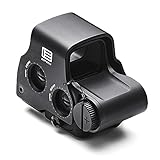
- EOTECH EXPS3-0 – Holographic Weapon Sight in black with 68 MOA ring & 1 MOA dot reticle
- Night Vision Compatible – Works with all Gen 1-3 night vision devices
- Side Button Operation – Compact design and side button operation consumes minimal rail space and is ideal for use with a G33 Magnifier
The Technology Difference
Holographic sights work fundamentally differently than LED red dots. Instead of projecting a simple light point, they create a laser-light hologram suspended in the viewing window. This complex light pattern appears clearer to astigmatic eyes because it’s not a single point source.
Through my astigmatic eyes, the 68 MOA ring with 1 MOA center dot appears remarkably clear. Yes, there’s slight fuzziness if I focus on the reticle itself, but when focusing on targets (as you should), it sharpens considerably. The improvement over traditional red dots is dramatic.
Field Performance
The EXPS3 excelled in every lighting condition tested. Bright sun that turns regular red dots into unusable starbursts left the holographic reticle clearly visible. The 20 daylight brightness settings provided perfect intensity for any situation.
Accuracy proved exceptional despite my vision issues. Five-shot groups at 50 yards averaged 1.5 inches – comparable to using iron sights when my eyes were younger. The large ring enables fast close-range acquisition while the center dot allows precision at distance.
Battery life remains the primary weakness at roughly 1,000 hours. However, the CR123 batteries are widely available, and the auto-shutoff feature extends practical runtime. I change batteries quarterly as preventive maintenance.
The Investment
At around $650, the EXPS3 costs serious money. But for shooters whose astigmatism renders cheaper red dots unusable, it’s worth every penny. The clarity improvement is like wearing prescription glasses for the first time – suddenly everything works as intended.
Primary Arms MicroPrism: The Etched Solution
The SLx 1X MicroPrism took me by surprise. After a month of testing and 800 rounds, this compact prism sight proved that etched reticles might be the ultimate astigmatism solution.

- ACSS Cyclops Gen II reticle, Etched Reticle, Works without illumination, Diopter for precision reticle clarity
- About half the size of our Compact 1x Prism and over 20% lighter
- 13 Illumination settings including true Daylight Bright, 29,000 Hour battery life at medium setting, Uses (1) CR2032 Battery (Included)
Why Etched Reticles Excel
Unlike projected dots, etched reticles are physically cut into glass. Your astigmatism can’t distort what’s literally etched in place. The ACSS Cyclops reticle appears perfectly sharp regardless of eye issues, lighting conditions, or battery status.
Even with dead batteries, the black etched reticle remains visible and usable. This reliability matters for defensive rifles where electronic failure isn’t acceptable. The illumination simply makes it easier to see, not possible to see.
Prism Sight Trade-offs
The MicroPrism requires specific eye relief, unlike unlimited-eye-relief red dots. At 3.6 inches optimal, you need consistent cheek weld. This takes adjustment but becomes natural with practice.
Weight increased slightly versus red dots – 7.6 ounces with mount versus 3-4 ounces for typical dots. On a rifle, barely noticeable. On a pistol, it matters more.
The diopter adjustment deserves special mention. Like focusing binoculars, you can tune the reticle to your specific vision. This customization dramatically improves clarity for astigmatic eyes.
Real Innovation
The AutoLive motion-sensing technology impressed me. It wakes when moved, sleeps when stationary. Combined with 29,000-hour battery life, you can leave it on indefinitely. No more dead batteries at critical moments.
At around $300, the MicroPrism costs more than basic red dots but less than premium options. For astigmatism sufferers, it’s the best value available – guaranteed clear reticle regardless of eye issues.
Holosun HS510C: Technology Meets Value
Two months and 1,000 rounds proved the HS510C delivers impressive clarity for astigmatic eyes at a reasonable price point. Chinese manufacturing raises eyebrows, but performance speaks louder than origin.

- Multi-Reticle System (MRS): Choose between a 2 MOA dot, 65 MOA circle, or a circle-dot combination
Multiple Technologies
The HS510C combines several features that help astigmatism:
- Large viewing window reduces distortion
- Multiple reticle options (dot, circle, both)
- Solar backup with auto-brightness
- Quality glass with good coatings
The 65 MOA circle with 2 MOA dot provides options. Some days my astigmatism prefers the circle, others the dot appears clearer. Having both available adapts to changing conditions.
Practical Performance
Solar failsafe technology proved valuable during extended range sessions. Even with a dead battery, daylight operation continues. The shake-awake feature means it’s always ready when grabbed.
The titanium hood and aluminum housing survived drops, rain, and general abuse without issues. The open design requires occasional cleaning but nothing excessive. Build quality exceeds the $350 price point.
Through testing, the reticle appeared clearer than most traditional red dots but not quite matching the EXPS3’s holographic clarity. For half the price, it’s an acceptable compromise.
Value Proposition
At $350 street price, the HS510C occupies the sweet spot between budget and premium. It’s not the absolute best for astigmatism, but it’s good enough while adding useful features. For hunters and recreational shooters, it makes sense.
Sig Romeo5: Budget Performance
The Romeo5 surprised me. At around $150, I expected compromises. After 1,000 rounds over six weeks, it proved budget doesn’t always mean bad for astigmatic eyes.

- HIGH PERFORMANCE – Lightweight and crystal clear, the Sig Sauer Romeo5 Tread Red Dot Sight is designed for those up close situations when you need to find your target quickly; This compact sight with 1x aiming solution is optimized for the SIG M400 Tread
What Works
The 2 MOA dot appears cleaner than many expensive competitors. While not perfect, the starburst effect stays minimal at reasonable brightness settings. Turning brightness down to level 4-5 dramatically improves clarity.
MOTAC (Motion Activated Illumination) extends the already impressive 40,000-hour battery life. It wakes instantly when moved, preventing both dead batteries and forgotten activation. Simple but effective.
Build quality exceeds the price point. It survived drops, water submersion, and thousands of rounds without losing zero. The aluminum housing and IPX-7 waterproofing match optics costing twice as much.
Limitations
Glass quality is good, not great. Some edge distortion appears, and light transmission falls short of premium options. For a budget optic, acceptable. For precision work, limiting.
The dot still shows some distortion to astigmatic eyes. Better than most at this price, but not matching holographic or etched alternatives. Manageable with brightness adjustment and proper technique.
Budget Reality
For $150, the Romeo5 delivers remarkable value. It won’t match $600 optics, but it gets you 70% of the performance at 25% of the cost. For new shooters or budget builds, it’s the smart choice.
What Didn’t Work
Not every highly-recommended optic worked for astigmatic eyes. Some expensive failures:
Trijicon MRO: Despite the excellent reputation and $450 price, the MRO showed significant starburst through my eyes. The blue tint annoyed me, and parallax issues appeared at close range. Others love it; my astigmatism doesn’t.
Vortex SPARC Solar: The solar feature attracted me, but the dot appeared as a massive starburst regardless of brightness settings. For $400, unacceptable performance for astigmatic eyes.
Cheap Amazon Specials: Various $50-100 red dots all showed severe distortion. Save your money. Bad glass and poor LED quality make astigmatism worse, not better.
Choosing the Right Technology
After extensive testing, clear patterns emerged for astigmatism-friendly optics:
Best: Etched Reticles
Prism sights with etched reticles provide guaranteed clarity. Can’t distort what’s physically etched. The Primary Arms MicroPrism leads this category.
Excellent: Holographic Sights
True holographic technology (not marketing speak) delivers dramatic improvement. EOTech dominates this space for good reason.
Good: Quality LED with Large Windows
Some traditional red dots work acceptably with astigmatism. Large viewing windows, quality glass, and adjustable brightness help. The Holosun 510C and Sig Romeo5 represent this category.
Poor: Cheap Red Dots
Budget red dots universally disappoint astigmatic eyes. Poor LED quality and cheap glass amplify distortion. Avoid unless you enjoy frustration.
Real-World Applications
Different uses revealed varying importance of astigmatism correction:
Home Defense
Clarity matters but isn’t critical at room distances. Even with moderate starburst, center-mass hits remain achievable. The Romeo5 works adequately here.
Competition
Precision matters. Astigmatism-induced groups cost points. Invest in holographic or etched options. The EXPS3 or MicroPrism excel here.
Hunting
Depends on distance and game. For close woods hunting, moderate distortion won’t matter. For precise longer shots, clear optics become critical. The HS510C balances features and clarity.
Training/Practice
High volume shooting justifies quality optics. Frustration from poor clarity reduces training effectiveness. Buy once, cry once – get the MicroPrism.
Common Questions Answered
“Can prescription glasses fix red dot distortion?”
Sometimes. My distance prescription slightly improves dot clarity but doesn’t eliminate distortion. Glasses specifically corrected for astigmatism might help more. Try before buying expensive optics.
“Does dot color matter?”
Marginally. Green dots sometimes appear clearer than red to my eyes, but individual variation exists. Technology matters more than color. Test both if possible.
“Will astigmatism get worse?”
Usually gradually worsens with age. My distortion increased noticeably over the past decade. Invest in quality optics that’ll remain usable as vision changes.
“Can I train around astigmatism?”
Partially. You can learn to use distorted dots effectively for minute-of-bad-guy accuracy. But precision shooting requires clear optics. Don’t handicap yourself unnecessarily.
“Is LASIK worth it for shooting?”
Consult an ophthalmologist. Some shooters report dramatic improvement, others minimal change. LASIK isn’t specifically for astigmatism correction. Research thoroughly.
Final Recommendations
Plan for the worst, hope for the best, and buy optics that work with your actual eyes, not theoretical perfect vision.
For maximum clarity regardless of cost: Get the EOTech EXPS3. Holographic technology provides the clearest sight picture for most astigmatic eyes. Yes, it’s expensive. Yes, battery life is shorter. But it works.
For guaranteed clarity with practical features: Choose the Primary Arms SLx MicroPrism. Etched reticles can’t distort, period. Add excellent battery life and reasonable pricing for the total package.
For value with good performance: The Holosun HS510C balances features, clarity, and cost effectively. Not perfect but good enough for most applications.
For budget builds: The Sig Romeo5 delivers surprising clarity at an affordable price. With brightness adjustment and realistic expectations, it’s completely usable.
Remember, practice is permanent, so practice it right. Don’t struggle with unusable optics because someone without astigmatism recommended them. Test before buying when possible, and invest in quality that works with your eyes.
The wilderness doesn’t care about your vision problems, and neither do threats. Having tested these optics through thousands of rounds and varying conditions, I’m confident these recommendations will serve shooters with astigmatism well.
Your vision is unique. What works for my astigmatism might not work for yours. But these four options provide the best starting points based on extensive testing. One of them should deliver the clear sight picture you’ve been searching for.
Looking for more honest gear reviews from someone who actually uses this stuff? Check out our comprehensive optics guides and field-tested equipment recommendations at Moosir.com. Because the best sight is the one you can actually see through clearly.