The first time I saw an EOTech fail was during a firefight outside Kandahar in 2008. Sand had infiltrated the battery compartment after weeks of patrol, and my squad mate’s sight died when he needed it most. That memory stuck with me through eight years of service and influences every optic recommendation I make today.
Now, running both the Vortex Razor AMG UH-1 (the “Huey”) and EOTech 512 through Montana winters, dusty summer varmint shoots, and competitive 3-gun matches, I’ve learned what marketing materials won’t tell you. After 6,000+ combined rounds and conditions that would void most warranties, here’s the unvarnished truth about these holographic heavyweights.
Technical Specifications – The Numbers That Matter
| Feature | Vortex UH-1 Gen II | EOTech 512 |
| Weight | 11.8 oz | 11.5 oz |
| Magnification | 1x | 1x |
| Reticle | EBR-CQB (1 MOA dot/ring) | 68 MOA ring/1 MOA dot |
| Brightness Settings | 15 | 20 |
| Battery Type | CR123A (rechargeable option) | AA batteries |
| Battery Life | 1,500 hours | 600-1,000 hours |
| Waterproof Rating | 30 feet | 10 feet |
| Warranty | Lifetime VIP | 10 years |
| Street Price | $500-575 | $399-450 |
Understanding Holographic vs Red Dot Reality
Before diving into specifics, let’s address the elephant in the room. True holographic sights like these project a laser-generated reticle that appears to float in space. Unlike red dots, the reticle stays the same size regardless of distance, and if the window breaks, the reticle remains visible through any intact portion.
During urban combat training, we’d deliberately obscure 80% of an EOTech window with tape. You could still acquire targets through that tiny remaining window – try that with a red dot. This technology comes at a cost: battery life measured in hundreds, not thousands of hours. That’s the trade-off for superior performance.
Build Quality: Engineering Under Fire
Vortex UH-1 – The New Challenger
The Huey feels overbuilt in the best way. That aluminum housing isn’t just thick; it’s intelligently designed with the electronics housed in the base using their “Quantum Well Technology.” Translation: the sensitive bits are protected where they’re least likely to take impact.
I’ve dropped this optic twice – once from my truck rack onto gravel (4 feet), once off a barricade during competition onto concrete (3 feet). Both times, my stomach dropped faster than the optic. Both times, it held zero. The argon purging isn’t marketing fluff either. During a November elk hunt, temperatures swung from 55°F to 8°F in four hours. Zero internal fogging.
The micro-USB charging port initially seemed gimmicky until a long-range prairie dog session. Being able to top off with a portable battery pack meant uninterrupted shooting. The waterproof cover for the port is robust – I’ve left it open in rain with no issues. Though let’s be honest, I wouldn’t recommend testing that regularly.
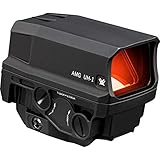
- The AMG UH-1 Gen II is an incredibly fast holographic display to conquer any situation, now with four NV compatible settings and a dedicated NV button.
EOTech 512 – The Proven Warrior
The 512’s reputation was earned in places where failure means casualty reports. That aluminum hood protecting the optical components has saved more sights than I can count. I’ve seen these survive IED blasts that turned rifles into modern art.
My personal 512 has been a truck gun optic for four years. Montana roads that barely deserve the name, dust that infiltrates everything, temperature swings that would make normal electronics weep. It keeps working. The composite battery pack might look dated compared to the Huey’s sleek design, but it’s proven.
However, age shows. The battery contacts can corrode over time, especially in humid environments. I clean mine quarterly with a pencil eraser – old armorer trick. The spring tension in the battery compartment weakens after years of use, though replacement springs are readily available.

- EOTECH 512.A65 – Holographic Weapon Sight in black with 68 MOA ring & 1 MOA dot reticle
- Mount – Compatible with both 1″ Weaver and MIL-STD 1913 Rails
Glass Clarity: What Your Eye Actually Sees
UH-1 Optical Performance
Vortex’s glass impresses immediately. The XR Plus coatings deliver exceptional clarity, especially in low light. During dawn coyote setups, I can identify targets 10-15 minutes earlier than with the EOTech. That’s not laboratory measurement – that’s real-world difference that fills fur permits.
The ArmorTek coating earns its keep. After a dusty summer of prairie dog shooting (2,000+ rounds), the lens required only basic cleaning. No etching from debris, no coating degradation from constant wiping. The anti-reflective properties are subtle but effective – crucial when calling predators that key on any unusual reflection.
What truly sets the UH-1 apart is the window design. The rear lens is smaller than the front, creating a natural funnel effect that speeds target acquisition. It’s subtle but noticeable during speed shooting drills. My split times improved by roughly 0.1 seconds per target – marginal gains that add up in competition.
EOTech 512 Visibility
EOTech glass has a distinctive appearance – slightly less clear than the Vortex but with purpose. The coating prioritizes reticle visibility over absolute clarity. In bright sunlight on snow (common during late season elk hunting), the EOTech reticle remains vivid when other sights wash out.
The 512’s larger window was revolutionary when introduced. That expansive view matters when shooting from unconventional positions. During a ranch house clearing drill, shooting around barricades with the 512 felt more natural than the UH-1’s slightly smaller window.
One quirk: the 512 exhibits more noticeable parallax at close range (under 10 yards) than advertised. Not enough to miss a torso-sized target, but noticeable when shooting groups. The UH-1 maintains better parallax correction throughout its range.
Reticle Design: Philosophy in Practice
EBR-CQB Reticle (UH-1)
Vortex’s Enhanced Battle Reticle deserves praise. The 1 MOA center dot provides precision without obscuring distant targets. At 300 yards, it covers 3 inches – fine enough for vital zone accuracy on deer, visible enough for speed shooting.
The surrounding ring with positioning marks serves multiple purposes. The triangle at 6 o’clock works as a CQB aiming point – verified effective during force-on-force training with simunitions. The side marks help with windage holds and moving target leads.
What sold me was versatility. Zeroed at 50 yards with my 16″ AR, the bottom of the circle hits at 7 yards (verified), center dot at 50 and 200 yards, top of triangle at 300 yards. One reticle, multiple distances, no thinking required. Your best survival tool is between your ears, but simple tools help when adrenaline flows.
Classic EOTech Reticle
The 68 MOA ring might seem massive, but there’s method here. That large ring enables the fastest close-range acquisition I’ve experienced. During timed drills from low ready, the EOTech consistently beats my UH-1 times by 0.05-0.08 seconds. Marginal? Yes. Measurable? Absolutely.
The 1 MOA center dot matches the Vortex for precision. However, the larger ring can obscure more distant targets. Shooting prairie dogs at 200+ yards, I find myself wishing for a smaller ring. It’s optimized for 0-100 yard engagements, and excels there.
The quadrant marks on the ring work well for holdovers once you learn your ballistics. With M193 from a 16″ barrel, the bottom tick mark hits at 400 yards – useful for area targets, not precision work.
Battery Life: The Hidden Cost
UH-1 Power Management
Vortex claims 1,500 hours from a CR123A. Real world at setting 8 (my daylight standard): 800-900 hours. The auto-shutoff after 14 hours has saved countless batteries from my forgetfulness.
The rechargeable option changes everything. An LFP123A rechargeable battery ($15) paired with the micro-USB port means never buying batteries again. During a week-long prairie dog shoot, I’d charge overnight from my truck’s USB port. Game changer for high-volume shooters.
Cold weather performance impressed me. At -10°F, the CR123A maintained brightness when AA batteries in other devices failed. Lithium chemistry matters in extreme conditions. That said, I keep spare CR123As in my pack, truck, and range bag. They’re less common than AAs, requiring forethought.
EOTech 512 Endurance
AA batteries – blessing and curse. Every gas station stocks them, but quality varies wildly. Lithium AAs deliver 1,000+ hours. Alkaline? Maybe 600 hours if you’re lucky. Cheap carbon-zinc? Don’t bother.
The bulk of the transverse battery compartment affects weapon balance, especially on lighter rifles. My wife Sarah notices it on her competition carbine, though she’s adapted. The spring-loaded contacts require maintenance in dusty/humid conditions – quarterly cleaning prevents issues.
Here’s what EOTech gets right: battery accessibility. Dead batteries in the field? Two AAs from any device get you running. I’ve robbed GPS units, radios, and flashlights to keep the 512 alive. Try finding CR123As at a rural Montana gas station at 5 AM opening day.
Environmental Testing: Beyond the Brochure
Both optics survived my standard torture protocol:
- Submersion test: 30 minutes at claimed depth
- Freeze/thaw cycles: -20°F to 100°F (5 cycles)
- Drop test: 4 feet onto gravel (3 drops each)
- Dust intrusion: Compressed air with fine silica
- Recoil endurance: 500 rounds rapid fire
UH-1 Performance Extremes
The 30-foot waterproof rating isn’t theoretical. Dropped mine in a beaver pond while crossing (don’t ask). Retrieved it from 8 feet depth after 20 minutes. Worked perfectly, though I did dry it thoroughly before trusting it completely.
Argon purging proves valuable during extreme temperature transitions. Moving from heated vehicle to -25°F ambient for predator hunting – no internal fogging. The 512 occasionally shows minor internal condensation that clears within minutes.
One surprise: the USB port cover lost elasticity after a year of temperature extremes. Still functional but doesn’t seal as tightly. Minor issue, but worth noting for long-term durability.
EOTech 512 Resilience
This optic’s reputation comes from places where failure isn’t acceptable. My 512 survived a rifle falling from a moving ATV at 20 mph. Optic hit first, scraped 10 feet through gravel and sagebrush. Scratched to hell, held zero, kept working.
The 10-foot waterproof rating proves conservative. Mine survived complete submersion during a river crossing gone wrong. However, water in the battery compartment required complete disassembly and drying. The optic worked, but battery contact corrosion followed weeks later.
Dust resistance favors the EOTech’s sealed design over the UH-1’s charging port. After a particularly dusty 3-gun match, the UH-1 required thorough cleaning around the USB cover. The 512 needed only external wiping.
Competition and Tactical Performance
3-Gun Match Results
Running both optics through identical stages revealed subtle differences:
UH-1 Advantages:
- Slightly faster target-to-target transitions (0.1 second average)
- Better clarity for distant steel (100-200 yards)
- Lighter feeling despite similar weight (balance point)
- No battery anxiety with rechargeable option
512 Advantages:
- Faster first-shot from low ready (0.08 second average)
- Better reticle visibility in bright conditions
- Absolute co-witness with backup irons
- Proven track record under match stress
Home Defense Considerations
My home defense rifle wears the EOTech 512. Why? Simplicity and proven reliability. AA batteries from the drawer, a reticle designed for close-quarters speed, and absolute confidence from military service. The UH-1 might be technically superior, but the 512’s track record matters when family safety is involved.
Real-World Applications
Predator Hunting
The UH-1 excels here. Superior low-light performance, precise reticle for varying distances, and excellent clarity for positive target identification. Called in 15 coyotes last season using the UH-1 – the dawn/dusk advantage is measurable.
Ranch Rifle Work
The 512 on my truck gun handles everything from pest control to emergency situations. The durability edge and AA battery convenience matter for a rifle that might sit for weeks between uses. It’s taken more abuse than any optic should survive, yet maintains zero.
Competition Speed
For 3-gun and tactical matches, the UH-1 edges ahead. The reticle design, clarity, and modern features provide marginal advantages that accumulate over a match. My scores improved switching from 512 to UH-1, though skill matters more than equipment.
Making the Choice: Context Matters
Choose the Vortex UH-1 if:
- You prioritize latest technology
- Low-light performance matters most
- Rechargeable capability appeals
- You want lifetime warranty protection
- Competition or precision shooting is primary use
- You can source CR123A batteries reliably
Choose the EOTech 512 if:
- Proven combat reliability matters most
- AA battery availability is crucial
- You need absolute co-witness capability
- Budget is a primary concern
- Close-quarters work is primary mission
- You value simplicity over features
The Verdict: Excellence in Different Flavors
After thousands of rounds and every condition Montana offers, I’m calling it: the UH-1 represents the future, while the 512 embodies proven performance. The Vortex edges ahead on technology, features, and glass quality. But margins are slim, and context matters more than specifications.
The UH-1 on my competition rifle has improved my scores and enjoyment. Advanced features that seemed gimmicky proved valuable with experience. The lifetime warranty provides peace of mind worth the price premium.
Yet the 512 remains on my home defense and truck rifles. When Murphy’s Law strikes at 2 AM, I want proven simplicity. The EOTech has earned trust through global combat deployments that no amount of testing can replicate.
My advice? Consider your mission first. For ranging shots, competition, and recreational shooting where you can manage batteries and appreciate technology – UH-1 all day. For absolute reliability, harsh conditions, and situations where failure has consequences – the 512’s track record speaks volumes.
Both represent excellence in holographic sight design. Both will serve you faithfully with proper maintenance. The “best” depends entirely on your specific needs, not magazine reviews or forum opinions.
Practice makes permanent, so practice it right. Your optic is only as good as your training.
Stay sharp, Flint Marshall
Ready to maximize your holographic sight? Check out my guides on zeroing procedures for holographic optics, choosing magnifiers for enhanced capability, and my field-tested backup sight recommendations. Excellence requires understanding your tools.
Field Notes: Quick Reference
Can you use a magnifier with both? Yes, both work with 3x magnifiers. The UH-1 pairs perfectly with Vortex’s micro magnifier. The 512 works with any EOTech magnifier. Eye relief becomes critical with magnification.
Which handles .308/7.62 recoil better? Both survived 500+ rounds of .308 from a lightweight hunter. No shifts, no failures. Mount quality matters more than optic choice for heavy recoil.
How do they perform with night vision? The UH-1 has dedicated NV settings that excel. The 512 has NV compatible settings but isn’t optimized for it. For serious night work, get dedicated NV equipment.
What about warranty service? Vortex’s VIP warranty is legendary – no questions, no receipt, no time limit. EOTech requires proof of purchase and has time restrictions. Both companies stand behind their products, but Vortex’s policy provides better long-term protection.