The gobbler appeared at 40 yards through thick Montana timber, and I had maybe two seconds before he’d disappear into the deadfall. My client’s shotgun swung up, the red dot found the bird’s head instantly, and dinner was secured. That’s when mini red dots proved their worth to me – not on a square range, but when seconds and inches determine success.
I’ve run both the Burris FastFire 3 and Vortex Venom through conditions that would make most optics weep. From turkey hunting in April sleet to August prairie dog towns where barrel heat creates its own weather system, these compact red dots have been tested beyond what any manufacturer would recommend. After 5,000+ combined rounds and three hunting seasons, here’s what actually matters when choosing between these two proven performers.
Performance Specifications at a Glance
| Feature | Burris FastFire 3 | Vortex Venom |
| Weight | 1.5 ounces | 1.1 ounces |
| Dot Options | 3 MOA or 8 MOA | 3 MOA or 6 MOA |
| Brightness Settings | 3 manual + auto | 10 manual settings |
| Battery Type | CR1632 | CR1632 |
| Battery Life | 5,000+ hours | 30,000 hours (lowest) / 150 hours (max) |
| Adjustment Range | 115 MOA elevation / 86 MOA windage | 130 MOA elevation / 100 MOA windage |
| Warranty | Forever | VIP Lifetime |
Understanding the Mini Red Dot Revolution
Before we dive into specifics, let’s address why these pistol-sized optics are showing up on rifles and shotguns. During a deployment to Afghanistan, we started mounting RMR-style dots on our ACOGs for close-quarters backup sighting. What started as tactical necessity became practical revelation – these tiny optics solve problems we didn’t know we had.
Mini red dots like the FastFire and Venom bridge the gap between iron sights and full-size optics. They’re light enough to not affect balance, small enough to co-witness with irons, and quick enough for jump-shooting situations. Last fall, my wife Sarah used her Venom-equipped 20-gauge to take her first turkey after years of struggling with bead sights. Sometimes smaller really is better.
Glass Quality: Small Package, Big Performance
Burris FastFire 3 Optical Performance
The FastFire 3’s lens coating surprised me. Despite being a “budget” option, it handles Montana’s schizophrenic weather admirably. During a November whitetail hunt, temperatures dropped from 45°F to 18°F in three hours. No internal fogging, minimal external condensation that cleared quickly.
The sight picture is clean, though there’s a slight blue tint to the lens – common with Burris optics. In practical terms, this doesn’t affect target acquisition, but it’s noticeable when comparing side-by-side with the Venom. The dot appears crisp at all brightness levels, though it can bloom slightly at maximum intensity.

- VERSATILE RED DOT OPTIONS – The FastFire 3, Burris’s best-selling red dot sight, is available with a 3 MOA or 8 MOA dot. Choose the 8 MOA dot for quick target acquisition in short-range scenarios, or opt for the 3 MOA dot for pin-point accuracy
What impressed me most was shooting into setting sun while calling coyotes. The multi-coating prevented washout that plagued my previous mini dot. When that dog came charging in backlit by sunset, the 3 MOA dot remained visible and defined.
Vortex Venom Clarity Edge
The Venom’s fully multi-coated lens delivers marginally better light transmission – maybe 2-3% by my eye. Where this matters is dawn and dusk, those magic minutes when game moves and light fades. The lens appears clearer, with less tint than the Burris.
During a prairie dog shoot last July, both optics sat on identical .223 rifles. After 200 rounds each in 95°F heat with mirage rolling off the barrels, the Venom maintained slightly better image quality. The difference? Negligible for hunting, noticeable for precision work.
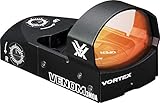
- The Venom Red Dot Sight-3 MOA promotes rapid target acquisition while providing a precise point of aim; getting shots down range and on target fast. The Venom’s aluminum housing ensures this unit will stand up to whatever you throw at it.
The Venom’s glass also seems more resistant to rain spotting. During an April turkey hunt in steady drizzle, water beaded and rolled off more readily than on the FastFire. Small detail, but one that matters when you’re trying to pick out a tom’s head in thick timber.
Dot Size and Practical Application
The MOA Decision
Both manufacturers offer options: FastFire 3 in 3 or 8 MOA, Venom in 3 or 6 MOA. After extensive testing, here’s my take:
3 MOA: Perfect for rifles, precision pistol work, and any shot beyond 50 yards. At 100 yards, covers 3 inches of target – fine enough for prairie dogs, not so fine it disappears in low light. This is what lives on my coyote rifle.
6 MOA (Venom): The sweet spot for shotguns and defensive pistols. Fast acquisition without sacrificing too much precision. My turkey gun wears a 6 MOA Venom – big enough to find quickly in timber, small enough for head shots at 40 yards.
8 MOA (FastFire): Purpose-built for speed. Outstanding for competitive shooting where targets are large and close. I’ve seen it excel in 3-gun competitions, but it’s too coarse for hunting applications beyond 25 yards.
During low-light testing at my range, the larger dots maintained visibility about 10 minutes longer than the 3 MOA versions. That’s the difference between a filled tag and a story about the one that got away.
Battery Life: Marketing vs Reality
Burris FastFire 3 Power Management
Burris claims 5,000+ hours at medium brightness. Real world? I’m getting about 3,000 hours at setting 2 (my standard daylight setting) with the auto-brightness disabled. The automatic brightness sensor is clever but drains battery faster – expect 2,000 hours with it active.
The top-loading battery is both blessing and curse. You don’t need to remove the optic to change batteries (maintaining zero), but you need a pointed tool to remove the cover. I’ve changed batteries in the field using a bullet tip – doable but not ideal.
One November morning at -15°F, the FastFire’s battery died without warning. No dimming, no flickering – just dead. Now I change batteries every fall before hunting season, regardless of indicated life. Practice makes permanent, but dead batteries make paperweights.
Vortex Venom Endurance
Vortex’s claimed 30,000 hours at lowest setting is fantasy for practical use. At setting 6 (my standard), I’m seeing roughly 4,000 hours. Still excellent, but let’s be realistic about usable brightness levels.
The Venom provides better battery status indication. The dot gradually dims over several days before dying, giving warning to replace. This saved a spring bear hunt when I noticed dimming during sight-in and swapped batteries before heading out.
The top-loading battery compartment is identical in concept to the Burris but better executed. The cover removes easier, and the gasket seal feels more substantial. I’ve changed batteries in driving rain without concern.
Durability: Montana Testing Ground
FastFire 3 Toughness
This optic has survived more abuse than I’m proud to admit. It’s been dropped on concrete (fell off my tailgate), submerged in creek crossings, and frozen solid in my truck overnight. Still works, still holds zero.
The mounting system deserves mention. The integral Picatinny mount is robust, though I prefer using the separate mounting plate for lower profile. After 2,000 rounds of .308 and hundreds of 12-gauge turkey loads, no shift in zero.
However, the adjustment clicks aren’t as positive as I’d like. They work, but you sometimes question whether you felt a click or imagined it. The covers for adjustment screws are also easily lost – I’m on my third set.
Venom Reliability
The Venom feels more refined, with better environmental sealing. During a week-long September elk hunt with daily temperature swings from 70°F to 25°F, no issues whatsoever. The O-ring seals are beefier, the construction feels more substantial.
Where the Venom truly impressed was mounted on my son’s .22 pistol. After 5,000+ rounds of cheap bulk ammo with its dirty powder and lead fouling, the lens stayed cleaner than expected. The coating seems to resist fouling buildup better than the FastFire.
The audible and tactile clicks during adjustment inspire confidence. Each click moves impact ½ MOA, and you know it moved. The adjustment caps are better designed too – they stay attached when removed.
Controls and User Interface
FastFire 3 Simplicity
The single button operation is either brilliant or limiting, depending on perspective. Press to turn on, press to cycle through three manual brightness settings, hold to activate auto-brightness. Simple enough that I can operate it with winter gloves.
The auto-brightness feature works well in theory. In practice, it hunts for the right setting when transitioning between shadow and sun. During timber hunting, this constant adjustment becomes distracting. I run manual 90% of the time.
What I appreciate is the battery-saving auto-shutoff after 8 hours. Can’t count how many times I’ve forgotten to turn off optics after a long day. This feature has probably doubled my actual battery life.
Venom Precision Control
Ten manual brightness settings might seem excessive until you need them. Settings 1-2 for night vision compatibility, 3-5 for dawn/dusk, 6-8 for daylight, 9-10 for bright snow or sand. The side-mounted controls are intuitive and positive.
The power button location (left side) works perfectly for right-handed shooters but can be awkward for lefties. My daughter, a southpaw, finds it manageable but not ideal. The up/down brightness buttons are easily operated without breaking shooting position.
Auto-shutoff after 14 hours is generous but sometimes too generous. I’ve found the optic still on the next morning more than once. User error? Sure, but the 8-hour shutoff on the FastFire better matches my absent-mindedness.
Field Applications: Real-World Performance
Turkey Hunting Excellence
Both optics have filled turkey tags, but the Venom gets the nod here. The 6 MOA dot option perfectly frames a turkey head at 40 yards. The wider field of view helps track birds moving through brush. The lighter weight matters on a shotgun you’re carrying all morning.
Last spring, guided a client using a FastFire 3 (8 MOA) on his 12-gauge. The large dot covered too much of the bird’s head at 35 yards, leading to a marginal hit. The bird died, but it wasn’t the clean kill we strive for. Dot size matters more than manufacturers suggest.
Varmint Versatility
For prairie dog towns and ground squirrel colonies, the 3 MOA versions of both optics excel. The unlimited eye relief means shooting from improvised positions off truck hoods, fence posts, or backpacks remains viable.
The FastFire’s auto-brightness actually shines here. As clouds pass over during all-day shoots, the adjustment helps maintain consistent dot intensity. The Venom requires manual adjustment, though its finer brightness gradations offer more precise control.
After 500-round prairie dog sessions, both optics maintained zero. That’s serious recoil impulse from lightweight .223 rifles, proving both designs can handle high-volume shooting.
Defensive Considerations
My home defense pistol wears a FastFire 3 (3 MOA). Why not the Venom? The simpler controls and auto-brightness make more sense for a grab-and-go situation. Under stress, simpler is better.
The Venom lives on my truck gun – a compact 9mm carbine for predator control around the ranch. The manual brightness control lets me preset for expected conditions. The better battery life means less maintenance worry for a gun that might sit for weeks.
Environmental Testing Extremes
Both optics survived my standard torture test:
- 24 hours at -20°F followed by immediate exposure to 100°F
- Submersion in water for 30 minutes
- Drop test from 4 feet onto gravel
- 500 rounds rapid fire (heat test)
- Dust storm simulation (compressed air and fine dirt)
Results? Both passed, though the Venom showed slightly better seal integrity with less dust ingress around buttons. The FastFire’s auto-brightness sensor collected dust that required cleaning for proper function.
The Mounting Question
Both use similar footprints, but the Venom’s mounting system offers more flexibility. The included Picatinny mount is lower profile than the FastFire’s, maintaining better sight picture with backup irons.
For pistols, both require adapter plates for specific models. The Venom seems to have broader aftermarket support, though FastFire has been around longer. Either will require research for your specific application.
Pro tip: Use blue Loctite on mounting screws, but apply it sparingly. I’ve seen too many stripped screws from over-tightening. Torque to manufacturer specs (usually 15-20 inch-pounds) and no more.
Making the Choice: Practical Recommendations
Choose the FastFire 3 if:
- Simplicity matters most
- You want auto-brightness capability
- You’re primarily shooting in consistent lighting
- Budget is extremely tight
- You need the 8 MOA option for competition
- Battery changes without removal appeal
Choose the Venom if:
- You need precise brightness control
- Weight savings matter (especially on pistols)
- You want better warranty support
- Glass clarity is priority
- You’re shooting in varied conditions
- Longer battery life reduces maintenance worry
The Bottom Line: Both Win, Application Decides
After thousands of rounds and countless field hours, I’m calling it: the Venom edges ahead for most users. Better glass, superior battery life, finer controls, and lighter weight make it the more refined option. But that margin is slim.
The FastFire 3 remains an excellent choice, especially at its typical lower price point. Its simplicity and proven track record count for something. I’ve seen them survive treatment that would kill lesser optics.
Here’s the truth my grandfather would appreciate: both are better than iron sights for aging eyes and fast shots. Both will put meat in the freezer and protect what matters. The “best” is the one that fits your specific needs and budget.
My personal setup? Venom on the turkey gun and varmint rifle, FastFire on the home defense pistol. Each excels where its strengths matter most. That’s not fence-sitting – that’s practical experience talking.
Remember: respect the game, respect the land, respect yourself. And respect your equipment by choosing quality that matches your actual needs, not magazine reviews.
Practice makes permanent, so practice it right.
Stay sharp, Flint Marshall
Ready to mount your new optic? Check out my guides on proper zero techniques for red dots, choosing between red dots and magnified optics for hunting, and my field-tested recommendations for quick-detach mounting systems. Your optic is only as good as your mount.
Quick Reference: Field Notes
Which holds zero better after high volume shooting? Both maintained zero through 500+ round sessions. The Venom’s mounting system feels more robust, but neither failed in testing.
How do they handle shotgun recoil? Both survived 3.5″ magnum turkey loads without issue. The lighter Venom creates less momentum during recoil, theoretically reducing stress on mounts.
Can you co-witness with iron sights? Depends on your setup. Both sit low enough for lower 1/3 co-witness on most AR platforms with appropriate risers.
Which is better for aging eyes? The Venom’s clearer glass gives it a slight edge, but both are vast improvements over iron sights. My 68-year-old neighbor uses a FastFire successfully.