The crosshairs settled on the elk’s shoulder at 437 yards. Wind pushed hard from the left—maybe 8 miles per hour at our position, but who knew what it was doing in the canyon between us. My client’s breathing was ragged from the climb, his $3,000 rifle topped with a $200 scope he’d bought on sale. “Take your time,” I whispered, already knowing what would happen next.
The shot broke clean. The bullet sailed two feet over the bull’s back, and $5,000 worth of guided hunt trotted into the timber. That’s when he turned to me and said the words I’ve heard too many times: “I thought a scope was just a scope.”
After eight years with the Rangers, where optics meant life or death, and seventeen more years guiding hunters through Montana’s backcountry, I’ve learned that choosing the right scope matters as much as choosing the right rifle. Maybe more. Today, I’m sharing everything I’ve learned about rifle scopes—no marketing fluff, no brand worship, just practical wisdom earned through thousands of hours behind glass in conditions from Afghan mountains to Alaskan tundra.
Understanding Rifle Scopes: The Foundation
What a Scope Actually Does
A rifle scope is essentially a specialized telescope that does three critical jobs: magnifies your target, provides a precise aiming point, and gathers light to improve visibility. But here’s what most articles won’t tell you—a scope is also a liability. It adds weight, creates another failure point, and can turn a reliable rifle into a temperamental diva if chosen poorly.
My grandfather, who fed his family through the Depression with iron sights and Kentucky windage, would laugh at our modern dependence on optics. But he’d also appreciate that a quality scope extends ethical shooting range, improves accuracy in low light, and helps aging eyes stay in the game. The key word there? Quality.
The Hard Truth About Scope Selection
Before we dive into specifications, let’s establish some reality: 90% of missed shots aren’t the scope’s fault—they’re yours. Poor trigger control, bad positioning, and buck fever kill more opportunities than equipment failure. However, the wrong scope for your application guarantees failure, while the right scope maximizes your potential.
I’ve watched millionaire hunters with $5,000 Swarovski scopes miss easy shots, and I’ve guided blue-collar workers with budget Vortex glass who never miss. The difference? They understood their equipment and practiced with it religiously.
Magnification: How Much is Enough?
Breaking Down the Numbers
Magnification tells you how many times closer your target appears compared to naked eye. A 10x scope makes a deer at 300 yards appear as if it’s at 30 yards. Simple enough, but here’s where people mess up—they buy too much magnification.
Last season, I watched a client struggle to find a bull elk at 80 yards through his 5-25x scope set on 25x. By the time he dialed down and found the animal, it had moved into thick timber. Meanwhile, Sarah, my wife, dropped her cow elk at 200 yards with a simple 3-9x set on 6x. More isn’t always better.
Fixed vs Variable Power: The Real Considerations
Fixed Power Scopes offer simplicity and reliability. One magnification, no moving parts to fail, typically superior glass quality for the money. During my Ranger days, our M24 sniper systems wore fixed 10x Leupolds. Why? Because they worked every time, in every condition.
Pros:
- Lighter weight
- More reliable (fewer moving parts)
- Better glass quality per dollar
- Faster target acquisition (no fiddling with power rings)
- Perfect repeatability
Cons:
- Limited versatility
- Must match magnification precisely to intended use
Variable Power Scopes dominate the market for good reason—versatility. From 3x for jumping deer in thick timber to 9x for cross-canyon shots, one scope handles multiple scenarios.
Pros:
- Adaptable to varying distances
- Better field of view at low power
- More precise shooting at high power
- One scope for multiple rifles/uses
Cons:
- Heavier and more complex
- More expensive for equivalent glass quality
- Power rings can shift under recoil
- Temptation to use too much magnification
Magnification Guidelines from the Field
Based on thousands of shots in real conditions:
Close Range (0-200 yards):
- Brush hunting: 1-4x or 2-7x
- Home defense: 1-6x LPVO or red dot
- Dangerous game: 1-4x or fixed 2.5x
- Example: Last spring, black bear at 35 yards in thick cover—1x was almost too much
Medium Range (200-500 yards):
- Western deer hunting: 3-9x or 4-12x
- General purpose: 3.5-10x
- Precision shooting: 4-16x
- Example: Montana mule deer, open country, 3-9x handles 95% of shots
Long Range (500+ yards):
- Open country hunting: 5-20x minimum
- Target shooting: 10-40x or more
- Extreme long range: 5-25x or higher with quality glass
- Example: Wyoming antelope at 600+ yards demands 15x minimum for precise shot placement
The Universal Truth: If you could only own one scope for North American hunting, a quality 3-9x or 3.5-10x would handle 90% of situations effectively.
Objective Lens: Light Gathering and Clarity
Size Matters, But Not How You Think
The objective lens (the one away from your eye) determines light-gathering capability. Bigger objectives gather more light, providing brighter images in low-light conditions. But here’s what nobody mentions—big objectives create problems:
- Mounting height issues – Requires tall rings, poor cheek weld
- Weight penalty – Every ounce matters after mile 10
- Bulk – Snags on everything in thick cover
- Reflection – That big lens is a mirror to game
During a November whitetail hunt in Minnesota, my client’s 56mm objective lens caught the setting sun perfectly, spooking a mature buck at 150 yards. Meanwhile, my 40mm objective remained invisible. Sometimes less is more.
Practical Objective Sizes
28mm and smaller:
- Scout scopes and ultralight setups
- Adequate for daylight only
- Example: My truck gun wears a fixed 2.5×20 scout scope—perfect for its purpose
30-44mm:
- The sweet spot for most hunting
- Good low-light performance
- Standard ring height maintains proper cheek weld
- My choice: 95% of my rifles wear 40-44mm objectives
50mm:
- Excellent low-light capability
- Popular with long-range shooters
- Requires medium-high rings
- Worth it for dedicated long-range rifles
56mm and larger:
- Maximum light gathering
- Heavy and bulky
- Requires high rings
- Best for stationary shooting (stands, blinds)
The Exit Pupil Reality
Here’s the calculation most articles skip: Exit pupil = objective diameter ÷ magnification. This determines the beam of light reaching your eye. Human pupils dilate to about 7mm maximum in low light (less as we age).
A 3-9×40 scope at 6x gives 6.7mm exit pupil—perfect for dawn/dusk. That same scope at 9x drops to 4.4mm—noticeably dimmer. This is why quality 3-9×40 scopes are so versatile—they balance magnification and brightness perfectly.
Lens Coatings: Seeing Through the Marketing
What Coatings Actually Do
Lens coatings reduce reflection and increase light transmission. Every air-to-glass surface reflects about 4% of light uncoated. A scope with 8 surfaces loses 32% of available light without coatings. With proper multi-coating, that loss drops to under 5%.
But here’s the dirty secret: past “fully multi-coated,” you’re paying for diminishing returns. I’ve compared $3,000 scopes with proprietary 37-layer coatings against $500 fully multi-coated options. In 90% of conditions, the difference is negligible.
Coating Categories Decoded
Coated: Single layer on some surfaces. Avoid unless desperate.
Fully Coated: Single layer on all surfaces. Minimum acceptable standard.
Multi-Coated: Multiple layers on some surfaces. Marketing gray area.
Fully Multi-Coated: Multiple layers on all surfaces. The practical standard for quality optics.
Proprietary Coatings: HD, ED, XD, etc. Marginal improvements at premium prices.
Real-world test: During an Alaska brown bear hunt, rain and salt spray hammered our optics for a week. My client’s scope with “hydrophobic nano-coating” and my standard fully multi-coated Leupold both required constant wiping. The $2,000 price difference bought marketing, not performance.
Field of View: The Overlooked Specification
Why FOV Matters More Than You Think
Field of view—how much area you see through the scope—becomes critical in dynamic situations. Running game, multiple targets, or quick follow-up shots all demand adequate FOV. Yet most shooters obsess over magnification while ignoring FOV.
True story: Two seasons ago, a client wounded a bull elk at 300 yards because his 25x magnification left him unable to see the cow standing behind his target. At 10x, he would’ve seen both animals clearly. The gut-shot bull required four hours of tracking through deadfall hell. FOV matters.
Understanding the Numbers
FOV is expressed as feet at 100 yards. A scope showing 40 feet at 100 yards lets you see a 40-foot-wide area at that distance. At 300 yards, you’d see 120 feet. Higher magnification always reduces FOV—physics, not quality, determines this.
Guidelines from experience:
- Under 20 feet at 100 yards: Tunnel vision, difficult tracking
- 20-30 feet: Adequate for stationary targets
- 30-40 feet: Good balance of magnification and awareness
- Over 40 feet: Excellent for moving game and quick acquisition
Reticle Selection: More Than Crosshairs
The Big Three Reticle Types
Duplex Reticles: The standard for good reason. Thick outer posts guide your eye to center quickly, thin center wires allow precise aiming. After 40 years of refinement, the basic duplex remains unbeaten for versatility.
Perfect for:
- General hunting
- Quick target acquisition
- Low-light visibility
- Shooters who don’t want complexity
Mil-Dot/Tactical Reticles: Dots or hash marks at measured intervals for range estimation and hold-offs. Useful if you invest time learning the system, overwhelming if you don’t.
During military service, mil-dot reticles were mandatory. Now? I run simple duplex on most hunting rifles. Why? Because I use a rangefinder for distance and dial for elevation. The cluttered reticle just obscures my target.
Perfect for:
- Military/law enforcement
- Competition shooting
- Long-range precision
- Shooters willing to study their reticle
BDC (Bullet Drop Compensator) Reticles: Pre-calculated aiming points for specific distances. Great in theory, problematic in practice unless matched perfectly to your load and environmental conditions.
The problem: That BDC calculated for 55-grain 5.56 at sea level doesn’t work with your 77-grain handloads at 8,000 feet. I’ve seen more shots missed due to BDC confusion than helped by it.
Perfect for:
- Single-load shooters
- Known distance shooting
- Military with issued ammunition
- Shooters who verify actual POI at each distance
First vs Second Focal Plane: The Eternal Debate
First Focal Plane (FFP): Reticle grows with magnification, subtensions remain accurate at any power.
Pros:
- Holds and ranging work at any magnification
- No math required for reticle use
- Tactical/competitive advantage
Cons:
- Reticle tiny at low power
- Reticle thick at high power
- More expensive
- Can obscure small targets
Second Focal Plane (SFP): Reticle stays same size regardless of magnification.
Pros:
- Consistent reticle visibility
- Better for variable-power hunting scopes
- Less expensive
- Clear sight picture at all powers
Cons:
- Subtensions only accurate at one magnification
- Requires math for holds at other powers
My take: FFP for tactical/competition where you use reticle features. SFP for hunting where you want consistent reticle appearance. Despite what forums claim, neither is inherently superior.
Turrets and Adjustments: Getting on Target
Understanding Click Values
Most scopes adjust in 1/4 MOA increments (0.26″ at 100 yards). Some target scopes offer 1/8 MOA (0.13″), while tactical scopes typically use 0.1 mil (0.36″). Finer adjustments aren’t necessarily better—they’re just different.
Reality check: If you can’t hold the rifle steady to 1/4 MOA, 1/8 MOA adjustments won’t help. I’ve watched shooters obsess over click values while ignoring 2 MOA of wobble in their position.
Turret Types and Applications
Capped Turrets: Protected from accidental adjustment. Set-and-forget for most hunting.
Exposed Turrets: Quick adjustments for varying distances. Useful if you actually dial for distance.
Target Turrets: Tall, exposed, precise. Great for competition, terrible for hunting.
Locking Turrets: Best of both worlds—accessible but secure.
Pro tip: Unless you’re dialing elevation regularly, get capped turrets. I’ve seen too many “perfect zeros” ruined by turrets spinning in scabbards or cases.
The Parallax Problem
Parallax occurs when the reticle and target image aren’t on the same focal plane. Move your head, the reticle appears to shift on target. At longer ranges or higher magnifications, this causes misses.
Solutions:
- Fixed parallax (usually 100-150 yards): Fine for most hunting
- Adjustable objective: Rotating objective bell
- Side focus: Turret on left side of scope
- No adjustment: Budget scopes, accept the limitation
For shots under 300 yards, parallax rarely matters. Beyond that, or above 10x magnification, adjustment becomes critical.
Eye Relief: Protecting Your Face
The Scope Bite Reality
Insufficient eye relief plus heavy recoil equals scope cuts. I’ve stitched up dozens of “scope eye” wounds, mostly from magnum rifles with poor shooting positions. It’s not funny when it’s your eye.
Minimum safe eye relief by cartridge class:
- Rimfire: 2.5 inches
- Standard rifle (.308 class): 3.5 inches
- Magnum rifle: 4 inches
- Dangerous game: 4.5+ inches
But here’s what matters more: consistent eye relief. Whether 3 inches or 4 inches, your scope must provide full field of view at YOUR mounting position. Too short risks injury. Too long creates a tiny eyebox you’ll struggle to find under stress.
The Eyebox Secret
Eyebox—the area where your eye sees the full scope image—matters more than eye relief distance. Quality scopes offer forgiving eyeboxes. Cheap scopes demand perfect head position.
Field test: Mount your rifle quickly 10 times. If you hunt for the sight picture more than twice, the eyebox is too critical for field use. This is where expensive glass earns its price—not in absolute clarity, but in forgiveness.
Durability: What Actually Matters
Waterproofing and Fogproofing
Every scope claims “waterproof and fogproof.” Here’s what that actually means:
IPX4: Splashing water. Light rain only. IPX6: Powerful water jets. Heavy rain. IPX7: Submersion to 1 meter. Actually waterproof. IPX8: Deep submersion. Exceeds any hunting need.
Most quality scopes achieve IPX7. But waterproofing means nothing if the seals fail after two years. This is where warranty service matters more than specifications.
Shock Resistance
Scopes must survive:
- Repeated recoil (thousands of rounds)
- Drops and impacts
- Temperature extremes
- Vibration during transport
Military scopes undergo 5,000+ round testing. Your hunting scope might see 100 rounds yearly. Don’t pay military-spec prices for deer camp duty.
That said, I’ve destroyed “ruggedized” scopes with single impacts. Quality matters more than marketing claims. Proven brands earn reputations through decades of field use, not torture test videos.
Practical Scope Selection by Application
Home Defense/Patrol Rifle
Requirements: Fast acquisition, both-eyes-open capability, close to medium range
Recommendation: 1-6x or 1-8x LPVO, or quality red dot with magnifier
My setup: Trijicon VCOG 1-6x on patrol carbine. Why? Bomb-proof, great glass, etched reticle works without batteries.

- Red Horseshoe reticle matched with 175-grain .308 loads
- First focal plane allowing the ballistic reticle to be used at any magnification
Brush Hunting (Eastern Whitetail, Black Bear)
Requirements: Wide field of view, low magnification, good low-light performance
Recommendation: 1-4x, 2-7x, or 3-9x with 40mm objective
My setup: Leupold VX-3 2.5-8×36. Lightweight, clear, proven over 15 years of abuse.
Western Big Game
Requirements: Versatility for 50-500 yard shots, durability for horse/pack travel
Recommendation: 3-9x or 3.5-10x, maybe 4-12x for open country
My setup: Leupold VX-5HD 3-15×44. Covers every scenario from timber to prairie.
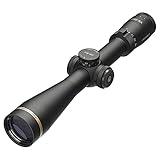
- Model #172368 – VX-5HD 3-15×44 Riflescope with an Illuminated FireDot Duplex Reticle, CDS-ZL2 and a Matte finish
Long-Range/Precision
Requirements: High magnification, precise adjustments, parallax adjustment
Recommendation: 5-25x or similar, FFP for competition, quality glass mandatory
My setup: Nightforce ATACR 5-25×56. Expensive but flawless through 10,000+ rounds.

- EXCEPTIONAL OPTICAL PERFORMANCE – The Nightforce ATACR – 5-25x56mm F1 hunting scope features top-tier ED glass, providing outstanding optical clarity and brightness. This ensures sharp, vivid images, even in challenging lighting conditions, enabling precise target identification and engagement
Dangerous Game
Requirements: Absolute reliability, low magnification, generous eyebox
Recommendation: 1-4x or fixed 2x, heavy duplex reticle, maximum eye relief
My setup: Trijicon Accupoint 1-4×24. Illuminated reticle without batteries, bulletproof construction.

- SUPERIOR QUALITY LENSES: Multi-coated lenses provide superior clarity and light gathering capabilities with zero distortion
- BATTERY-FREE ILLUMINATION: Fiber optic technology automatically adjusts the brightness level and contrast of the reticle aiming point to available light conditions and a tritium phosphor lamp illuminates the reticle in low to no light
The Money Question: Budgeting for Glass
The 50% Rule Revisited
Traditional wisdom says spend as much on the scope as the rifle. I disagree. Here’s my formula:
- Basic rifle (<$500): Spend $200-300 on optics
- Mid-range rifle ($500-1500): Spend $400-800 on optics
- Premium rifle ($1500+): Spend $600-1500 on optics
- Custom rifle: Sky’s the limit, but $1000-2000 handles anything
Beyond $1500, you’re paying for prestige and marginal improvements most shooters can’t utilize. That $3000 could buy three quality scopes for different rifles instead of one safe queen.
Brand Realities
Tier 1 : Schmidt & Bender, Tangent Theta, Zero Compromise. Perfection at painful prices.
Tier 2 : Nightforce, Leupold VX-6/Mark 5, Vortex Razor. Professional quality without a second mortgage.
Tier 3 : Leupold VX-3/VX-5, Vortex Viper, Zeiss Conquest. Sweet spot for serious hunters.
Tier 4 : Vortex Diamondback, Leupold VX-Freedom, Burris Fullfield. Acceptable quality, good warranties.
Below : Lottery ticket. Might work, might not. Fine for rimfire or backup rifles.
Mounting: The Critical Connection
Ring and Base Selection
Your scope mounting system is not where to save money. Quality rings and bases:
- Maintain zero through recoil
- Don’t damage scope tubes
- Provide consistent alignment
- Last forever with proper installation
Proven systems:
- Leupold PRW2 rings
- Warne rings and bases
- Talley lightweight
- Nightforce rings (overkill but perfect)
Avoid:
- See-through rings (unless you enjoy missing)
- Ultra-cheap aluminum rings
- Mix-and-match components
- Anything requiring excessive force to align
Professional Mounting Process
After mounting thousands of scopes, here’s my method:
- Degrease everything – Acetone or alcohol on all surfaces
- Mount bases – Blue Loctite, proper torque (usually 20-30 in-lbs)
- Lap rings if needed – Only if alignment is off
- Position scope – Eye relief perfect at YOUR shooting position
- Level reticle – Use quality level, verify with plumb line
- Tighten rings – Alternating pattern, proper torque (15-20 in-lbs typically)
- Verify function – Full turret travel without binding
Skip steps, create problems. I charge $100 to mount scopes properly. I charge $150 to fix someone else’s mounting job.
Zeroing: Making It Count
The Efficient Zero Process
Forget shooting 50 rounds to zero. Here’s the professional method:
- Bore sight – Gets you on paper
- Shoot one round at 25 yards – Adjust to point of impact
- Shoot three rounds at 25 yards – Fine tune to center
- Move to 100 yards – Shoot three-round group
- Adjust based on group center – Not individual shots
- Confirm with five rounds – Final group verifies zero
- Record settings – Document turret positions
Total rounds: 12-15. If it takes more, something’s wrong.
Zero Distance Philosophy
100-yard zero: Traditional, easy math, works for everything
200-yard zero: Flatter trajectory for Western hunting
50/200 zero (5.56): Combat proven for carbines
Maximum Point Blank Range: Optimal for hunting without dialing
My preference: 200-yard zero for general hunting rifles, 100-yard for precision rifles where I’ll dial elevation anyway.
Maintenance: Protecting Your Investment
Cleaning Protocol
Most scopes are overcleaned into problems. My routine:
External:
- Blow off debris with canned air
- Wipe lenses with microfiber only
- Lens pen for stubborn spots
- RainX on external lenses (controversial but effective)
Internal:
- Don’t. Ever. Sealed scope internals require no maintenance
Turrets:
- Annual drop of gun oil on threads
- Work through full range monthly
- Verify zero hasn’t shifted
Storage and Transport
- Quality scope covers always
- Rifle cases that prevent scope impact
- Remove for airline travel (TSA wrestling match)
- Climate-controlled storage when possible
- Annual inspection for seal integrity
Common Mistakes to Avoid
The Top 10 Scope Sins
- Too much magnification – If you’ve never shot past 300 yards, you don’t need 25x
- Cheap rings on expensive scopes – Like mounting a Ferrari engine with zip ties
- Ignoring eye relief – Scope bite isn’t a badge of honor
- BDC without verification – Those marks mean nothing without real-world confirmation
- Dirty lenses – 50% of “bad scopes” just need cleaning
- Trusting box specs – Marketing departments don’t hunt
- Mounting too high – Chin welds don’t work
- Over-tightening rings – Crushes tubes, ruins tracking
- Mismatched reticle/turrets – MOA reticle with MIL turrets = guaranteed confusion
- Buying features over quality – Better to have 3-9x that works than 5-30x that doesn’t
Field Wisdom: Lessons Learned the Hard Way
When Less is More
That 6-24x56mm tactical scope looks impressive at the range. But after packing it up Montana mountains, crawling through devil’s club in Alaska, or sitting in a Saskatchewan ground blind at -30°F, you’ll understand why my most-used scope is a simple 3-9×40.
Scout and River, my dogs, have watched me test dozens of scopes over the years. The fancy ones gather dust. The simple, reliable ones go hunting.
The One Scope Philosophy
If forced to choose one scope for all North American hunting, it would be a 3-10×42 with side focus, capped turrets, and simple duplex reticle. Boring? Yes. Effective? Absolutely.
This combination handles:
- Woods hunting on low power
- Open country on high power
- Low light with adequate objective
- Any reasonable shooting distance
- Rough handling without failure
Technology vs Fundamentals
Modern scopes offer incredible technology—illuminated reticles, bluetooth connectivity, built-in rangefinders, ballistic calculators. But I’ve guided successful hunts with fixed 4x scopes from the 1960s that still hold zero perfectly.
Technology helps, but fundamentals matter more. A skilled shooter with basic equipment outperforms a novice with space-age gear every time.
Making Your Decision
The Three Questions That Matter
Before buying any scope, answer honestly:
- What’s my actual shooting distance? Not dreams—reality. Check your hunting journal. Most shots are closer than you think.
- What are my conditions? Dense woods and open prairie require different tools. Dark timber and bright snow demand different solutions.
- What’s my commitment level? Complex systems require practice. Simple systems work without thinking. Choose accordingly.
The Final Formula
Here’s my recommendations based on 25 years of hard experience:
For 90% of hunters: Quality 3-9×40 or 3-10×42, second focal plane, duplex reticle, reputable manufacturer, $400-800 price range.
For specialists: Buy the specific tool for your specific need, understanding its limitations elsewhere.
For beginners: Start simple, upgrade with experience. Better to master basics than struggle with complexity.
Conclusion: The Truth About Scopes
After all these words about magnification, objectives, and reticles, here’s the truth: Your scope won’t make you a marksman. Only practice does that. But the right scope, properly mounted and zeroed, removes equipment from the equation. When you squeeze the trigger, you’ll know the bullet will go where the crosshairs point.
Choose your scope based on actual needs, not imagined scenarios. Buy quality you can afford, not features you won’t use. Then practice until the operation becomes instinctive.
The wilderness doesn’t care about your equipment. Neither does the game. But proper tools, combined with skill and woodsmanship, create consistent success. Your scope is just one tool in that system—important, but not magic.
Remember: Your best survival tool is the six inches between your ears. Your scope just helps it work at longer distances.
Stay safe, shoot straight, and respect the game, the land, and yourself.
For more field-tested wisdom and honest equipment reviews, keep reading Moosir.com. Plan for the worst, hope for the best, and always verify your zero.