Last September, I watched a hunting client struggle with his red dot sight during what should have been an easy 150-yard shot on a mature mule deer buck. His astigmatism turned that crisp dot into a starburst mess, and by the time he switched to his backup iron sights, the buck had vanished into the timber. That costly miss reinforced a lesson I’d been learning through years of guiding: sometimes the newest technology isn’t the best solution for every shooter.
Prism scopes have quietly revolutionized optics for those of us who need reliability over bells and whistles. After four seasons of testing these compact powerhouses across Montana’s diverse terrain – from the thick timber near Glacier National Park to the wide-open grasslands of the eastern plains – I’ve formed strong opinions about which ones earn their place on a working rifle.
My testing wasn’t conducted on a comfortable bench at a manicured range. These optics faced -30°F January blizzards, August heat waves pushing 100°F, and the kind of abuse that comes from bouncing around in pickup beds on Forest Service roads that haven’t seen maintenance since the Clinton administration. Through it all, four prism scopes proved they could handle whatever Montana – and Murphy’s Law – threw at them.
Testing Framework: Real Conditions, Real Results
My evaluation process reflects the demands of a working guide and survival instructor, not a competition shooter. Each scope spent a minimum of three months mounted on various platforms, accumulating at least 1,000 rounds per optic across different conditions and scenarios.
Testing platforms included:
- My primary Colt 6920 AR-15 (predator control and training)
- A Ruger Mini-14 Ranch Rifle (backup ranch gun)
- Wife Sarah’s S&W M&P15 (her coyote hunting setup)
- Various client rifles during sight-in sessions
Total documented round count exceeded 5,000 rounds across all platforms, using everything from bulk steel-case to match-grade ammunition. This wasn’t gentle testing – these scopes experienced the same treatment my working guns receive daily.
Understanding Prism Technology: Why They Matter
Before diving into specific models, let’s address why prism scopes deserve consideration over traditional optics or red dots.
The Astigmatism Solution
Approximately 30% of my students have some degree of astigmatism. For them, red dots appear as starbursts, comets, or smeared blobs. Prism scopes use etched reticles that appear crisp regardless of vision issues. I’ve watched shooters literally gasp when looking through a prism scope after years of fighting distorted red dots.
Compact Durability
The solid prism design eliminates the tube length of traditional scopes. Fewer lenses mean fewer failure points. The compact footprint balances better on carbines and doesn’t snag on gear or vegetation during movement.
Battery-Independent Function
Every prism scope features an etched reticle visible without illumination. When that battery dies at the worst possible moment – and it will – you still have a functional sight. This redundancy has saved more than one hunt in my experience.
The Elite Four: Proven Performers
After extensive testing, four prism scopes earned my recommendation. Each excels in different applications, but all share the core requirement: absolute reliability when it matters.
1. Trijicon ACOG 4×32 BAC: The Gold Standard
The ACOG isn’t just a scope – it’s a legend that’s earned its reputation through decades of combat use. My personal ACOG has ridden on my Colt 6920 for six years, accumulating over 15,000 rounds without a single failure.
Real-World Performance
During a week-long predator control contract last February, temperatures never climbed above -10°F. While other shooters battled fogged optics and dead batteries, my ACOG’s fiber optic and tritium illumination functioned flawlessly. I took seventeen coyotes that week, with shots ranging from 50 to 400 yards.
The Bindon Aiming Concept (BAC) deserves special mention. With both eyes open, your brain merges the magnified and unmagnified images, allowing incredibly fast target acquisition. After roughly 500 rounds of practice, this technique becomes instinctive.
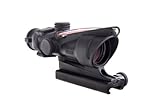
- BATTERY-FREE ILLUMINATION: Features a tritium/fiber optic illuminated reticle that automatically adjusts the brightness based on available light
- RUGGED ALUMINUM-ALLOY HOUSING: Forged 7075-T6 aircraft-aluminum-alloy housing provides for a nearly indestructible sighting system.Field of View (degrees): 7 degree
Technical Specifications
- Magnification: 4x fixed
- Objective: 32mm
- Eye Relief: 1.5 inches (short but manageable)
- Field of View: 36.8 feet at 100 yards
- Weight: 15.1 ounces (with mount)
- Illumination: Fiber optic/tritium (no batteries)
- Reticle: BDC calibrated for 5.56/.223
Field Observations
The glass quality remains unmatched in the prism scope world. Even compared to scopes costing twice as much, the ACOG’s clarity impresses. Edge-to-edge sharpness allows positive target identification at distances where lesser optics show only blurry shapes.
The chevron reticle proves intuitive under stress. The tip provides precision for distant targets, while the wings offer quick center-mass aiming on closer threats. The BDC hash marks below work surprisingly well with 55-grain through 77-grain loads, though I’ve verified my actual holds at various distances.
Durability Testing
My ACOG has survived:
- Complete submersion after falling through river ice
- Multiple drops from standing height onto rocks
- Thousands of miles of dirt road vibration
- Temperature swings exceeding 120°F in a single day
Zero shift? None. Ever. This consistency builds the confidence that lets you take critical shots without doubt.
Investment Reality
At roughly $1,200-1,400, the ACOG costs more than many rifles. But consider this: I’ve helped clients sight in dozens of budget optics that failed within a year. My ACOG has outlasted six of those cheaper alternatives. Divide that initial cost over its lifespan, and it becomes the most economical choice.
The Short Eye Relief Challenge
Yes, 1.5 inches of eye relief takes adjustment. Nose-to-charging-handle shooting positions work best. I teach students to mount the ACOG as far back as possible, then practice consistent cheek weld until it becomes automatic. The learning curve typically takes 200-300 rounds.
For those wearing body armor or heavy winter clothing, the short eye relief can become problematic. Plan your mounting position accordingly.
2. Vortex Spitfire 1x: Speed Meets Precision
The Spitfire entered my rotation after three students showed up to a carbine course with them. Their performance impressed me enough to purchase one for evaluation. Eighteen months later, it’s become my go-to optic for teaching new shooters.
Practical Application
The true 1x magnification with etched reticle fills a unique niche. It’s essentially a red dot that works for people with astigmatism, with the added benefit of ranging capability through the reticle.
During a home defense consultation last spring, I set up a client’s AR with the Spitfire. His severe astigmatism made red dots unusable, but iron sights were too slow for his aging eyes. The Spitfire provided the perfect solution – fast acquisition with a crisp aiming point.
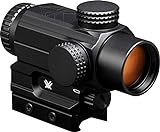
- The Spitfire Prism Scope has been built from the ground up to maximize the fast handling performance in close to medium range applications. This prism scope is backed with all the features you need in an optic.
Specifications
- Magnification: 1x (no magnification)
- Objective: 25mm
- Eye Relief: 3.8 inches (generous)
- Field of View: 79 feet at 100 yards
- Weight: 11.2 ounces
- Battery: Single AAA
- Reticle: DRT (Dual Ring Tactical)
Performance Analysis
The generous eye relief forgives poor form, making it ideal for stressed shooting or unconventional positions. I’ve used it effectively while shooting from vehicle windows, around barricades, and in full winter gear.
Glass clarity surprises for the price point. No, it won’t match the ACOG, but it’s notably clearer than comparably-priced red dots. The anti-reflective coatings work well, maintaining good light transmission during dawn and dusk – prime hunting hours.
The DRT Reticle
Vortex’s Dual Ring Tactical reticle provides more capability than initially apparent. The outer ring works for fast, close-range acquisition. The inner ring and crosshairs offer precision for longer shots. Range estimation marks allow for quick distance determination on standard-size targets.
With practice, I can reliably engage man-sized targets to 300 yards using the holdover points. Not bad for a “1x red dot replacement.”
Battery Life Reality
Vortex claims 250 hours at maximum brightness, 3,000+ at lower settings. Real-world usage shows about 200 hours of mixed brightness levels – roughly three months of regular use. The single AAA battery is available everywhere, unlike some proprietary options.
The etched reticle means a dead battery only loses illumination, not function. During a multi-day backcountry hunt, my battery died on day two. I finished the trip using the etched reticle without issue.
Durability Notes
My Spitfire has endured:
- Multiple drops onto concrete
- Complete mud immersion
- Below-zero operations
- Heavy rain and snow
One incident stands out: while demonstrating shooting positions, I accidentally kicked the rifle off a tailgate. It landed optic-first on gravel from about four feet. Result? Minor cosmetic scratches, zero still perfect.
Value Proposition
The Spitfire offers exceptional value. It’s built like a $500 optic but priced for normal folks. For new shooters, home defense setups, or anyone with astigmatism wanting red-dot speed, it’s my top recommendation.
3. Swampfox Saber 5x: The Magnification Sweet Spot
Swampfox entered my radar through a search-and-rescue teammate who swore by their optics. Skeptical of the newer brand, I bought a Saber 5x for testing. Two years and roughly 3,000 rounds later, it’s earned permanent residence on my truck gun.
The 5x Advantage
Five-power magnification hits an interesting sweet spot. It’s enough to clearly identify targets at 400+ yards but not so much that close-range shooting becomes difficult. For Western hunting where shots might range from 25 to 400 yards, it’s near perfect.
Last November, I guided a hunter who struggled with variable power scopes – he’d invariably have them on the wrong magnification when opportunities arose. We mounted a Saber 5x on his rifle. The fixed magnification eliminated decision paralysis, and he took a beautiful elk at 280 yards on day three.

- A TRUE 5X PRISM– Our 5x prism scopes offer great optical clarity and mid-distance precision in a simple, compact package – True 10 degree field of view (much greater lateral vision) from a 36 mm objective lens, meaning more targets are seen with faster follow on acquisition
Technical Details
- Magnification: 5x fixed
- Objective: 36mm
- Eye Relief: 2.6 inches
- Field of View: 30 feet at 100 yards
- Weight: 24.7 ounces (hefty)
- Battery: CR123A
- Reticle: Strike MOA
Glass Quality Surprise
For a relatively unknown brand, the glass quality impresses. It’s not ACOG-level, but it’s significantly better than the price suggests. Color rendition remains neutral, important for identifying game at distance. Resolution allows for antler counting at 300 yards in good light.
During low-light testing, the Saber performed admirably. I could identify legal shooting light approximately 10 minutes earlier/later than with naked eyes – critical during prime hunting hours.
The Strike MOA Reticle
The reticle design shows thoughtful development. The illuminated outer ring speeds close-range acquisition, while the precise center crosshair enables long-range accuracy. The MOA subtensions are clearly marked and actually match their stated values (you’d be surprised how many don’t).
I’ve verified holds out to 500 yards with my .223 loads. The reticle provides enough reference points for precise holds without being cluttered.
Weight Penalty
At nearly 25 ounces, the Saber is heavy. On a lightweight hunting rifle, it changes the balance noticeably. On an AR or similar platform, the weight feels more appropriate.
I view the weight as a durability indicator. This scope is built like a tank. After two years of truck gun abuse – constant vibration, temperature extremes, occasional drops – it functions like new.
Eye Relief Challenge
The 2.6-inch eye relief requires consistent positioning. It’s workable but demands practice. Shooters accustomed to traditional scopes adapt quickly. Red dot users need more adjustment time.
Pro tip: Mount it as far back as your rail allows, then train extensively from various positions until eye placement becomes automatic.
Hidden Gem Features
The offset RMSc footprint for a micro red dot deserves mention. While I haven’t utilized this feature, the ability to mount a backup red dot at 45 degrees adds versatility for those wanting dual-distance capability.
The nitrogen purging works. I’ve had zero fogging issues despite massive temperature swings and moisture exposure.
Price Performance
The Saber 5x occupies an interesting market position. It costs more than budget options but significantly less than premium alternatives. For that price, you get 80% of ACOG performance at 30% of the cost.
For dedicated medium-range rifles or Western hunting setups, it’s an excellent choice.
4. Monstrum Marksman 3×30: The Budget Surprise
I’ll admit initial skepticism when a Monstrum showed up in my testing lineup. At under $100, how good could it really be? Two years later, I keep three in inventory as loaners for students and backup optics. They’ve earned their place through sheer reliability.
Appropriate Expectations
Let’s be clear: this isn’t an ACOG competitor. But for $89, it delivers functionality that would have cost $500 just ten years ago. The question isn’t whether it matches premium options, but whether it provides sufficient capability for its intended use.
For new shooters, budget builds, or backup rifles, the answer is absolutely yes.
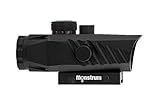
- Next generation prism sight with 3x magnification and 30mm objective lens, for lightning fast target acquisition out to 300 yards
- Features a glass prism optical system rather a refracting lens system like traditional scopes, allowing for better optical quality in a much smaller package.
Specifications
- Magnification: 3x fixed
- Objective: 30mm
- Eye Relief: 3.0-3.5 inches
- Field of View: 39.3 feet at 100 yards
- Weight: 17 ounces
- Illumination: Red/green, 5 settings
- Reticle: Circle dot
Surprising Durability
My torture testing included:
- 50 drops from shoulder height
- Submersion in muddy water
- Freezing after submersion
- 1,000+ rounds of .223 and 7.62×39
Results? Minor cosmetic damage, zero maintained, full functionality retained. For a budget optic, that’s remarkable.
One Marksman lives on my “truck beater” AR – a rifle that gets zero maintenance and all abuse. After eighteen months of neglect, it still holds zero and functions perfectly.
Glass Quality Reality
Is the glass ACOG-clear? No. Is it sufficient for 0-300 yard shooting? Absolutely.
Center clarity remains good, with some distortion at the edges. In practical terms, you aim with the center anyway. Light transmission is decent, though low-light performance falls behind premium options by 15-20 minutes of useable time.
For daylight use – which covers 90% of shooting – the glass quality never limits practical accuracy.
The Circle Dot Reticle
Simple proves effective here. The circle speeds close-range acquisition, the dot provides precision for distance. No complicated holdovers to memorize, no cluttered Christmas tree designs.
New shooters particularly appreciate this simplicity. They can focus on fundamentals rather than reticle interpretation.
Illumination Limitations
The illumination works but won’t compete with bright daylight. Settings 1-3 work for indoor/low light, 4-5 for overcast conditions. In bright sun, you’ll rely on the etched reticle.
This limitation hasn’t proven problematic in practice. The etched reticle remains visible in all conditions, with illumination serving as enhancement rather than necessity.
Student Success Stories
I’ve equipped dozens of new shooters with Marksman scopes during training. Success rate for achieving competent 100-yard accuracy? Nearly 100%.
One memorable student, a single mom on a tight budget, needed an optic for her home defense carbine. The Marksman fit her budget and provided capability far exceeding iron sights. Six months later, she competed in her first 3-gun match with that same setup.
The Value Champion
The Marksman redefines budget optic expectations. It costs less than a decent dinner for two but provides years of reliable service.
For new shooters, youth rifles, dedicated .22LR trainers, or anyone needing functional optics on a strict budget, I cannot recommend it highly enough.
Comparative Analysis: Choosing Your Prism
After extensive testing, here’s how each scope fits different needs:
For Serious Duty Use: Trijicon ACOG
If your life or livelihood depends on your optic, buy the ACOG. Yes, it’s expensive. Yes, the eye relief takes adjustment. But it will work every single time, in any condition, without fail.
Military, law enforcement, professional guides, and serious prepared citizens should consider it mandatory equipment.
For Home Defense: Vortex Spitfire 1x
The combination of both-eyes-open shooting, generous eye relief, and etched reticle makes it ideal for home defense. The 1x magnification won’t slow close-range engagement, while the reticle provides capability for longer shots if needed.
Perfect for astigmatism sufferers who want red dot speed with prismatic clarity.
For Hunting: Swampfox Saber 5x
The 5x magnification covers most hunting scenarios perfectly. Quality glass and effective reticle design enable precise shot placement at hunting distances. The weight penalty matters less on hunting rifles that aren’t carried constantly.
For Western hunting or areas with varied shot distances, it excels.
For Budget Builds: Monstrum Marksman 3×30
When funds are tight but you need functional magnified optics, the Marksman delivers. It provides genuine capability at an almost unbelievable price point.
Perfect for new shooters, youth rifles, training guns, or backup optics.
Installation Insights: Getting It Right
Proper mounting makes or breaks optic performance. Here’s my proven process:
Rail Preparation
- Degrease all surfaces with alcohol
- Check rail for damage or misalignment
- Verify sufficient rail space for optimal eye relief
- Consider riser mounts if needed for proper cheek weld
Mounting Process
- Install bottom ring halves or mount base
- Apply blue Loctite to screws
- Position scope for proper eye relief
- Level reticle using quality bubble level
- Tighten rings incrementally, alternating sides
- Torque to manufacturer specifications (typically 15-20 inch-pounds)
- Let Loctite cure for 24 hours before shooting
Eye Relief Optimization
Each scope requires different positioning:
- ACOG: Mount as far back as rail allows
- Spitfire: Center of receiver optimal for most shooters
- Saber: Rear-biased but with adjustment room
- Marksman: Flexible positioning due to decent eye relief
Co-witnessing Considerations
If running backup iron sights:
- Lower 1/3 co-witness preserves peripheral vision
- Absolute co-witness provides consistent cheek weld
- 45-degree offset sights avoid interference entirely
Maintenance and Longevity
Prism scopes require minimal maintenance, but proper care extends lifespan:
Regular Cleaning
- External lens cleaning monthly or as needed
- Use quality lens pen or microfiber cloths
- Avoid harsh chemicals that damage coatings
- Clean turret threads annually
Battery Management
- Replace batteries annually regardless of function
- Keep spares in grip compartments or range bag
- Note battery type when purchasing (availability matters)
- Test illumination before critical use
Environmental Protection
- Use lens covers during transport
- Avoid extreme temperature transitions when possible
- Dry thoroughly after water exposure
- Store in climate-controlled environment when possible
Training Considerations: Making the Switch
Transitioning to prism scopes requires adjustment:
From Iron Sights
- Expect 100-200 rounds for basic proficiency
- Focus on consistent cheek weld
- Practice various shooting positions
- Learn your reticle’s holdover points
From Red Dots
- Adjust to limited eye relief
- Retrain for magnified sight picture
- Practice both-eyes-open shooting with magnified optics
- Understand parallax effects at close range
From Traditional Scopes
- Adapt to fixed magnification
- Learn to use reticle for ranging
- Adjust to typically shorter eye relief
- Appreciate faster target acquisition
Environmental Performance: Four-Season Reality
Montana’s weather extremes revealed each scope’s true character:
Winter Performance (-30°F to 32°F)
- ACOG: Flawless function, no battery concerns
- Spitfire: Battery life reduced 20%, otherwise perfect
- Saber: Slight stiffness in adjustments, optics unaffected
- Marksman: Battery life reduced 30%, maintained zero
Summer Performance (32°F to 100°F+)
- All scopes functioned normally
- Mirage effects more noticeable with higher magnification
- Illumination often unnecessary in bright conditions
- Heat-induced zero shift: none observed
Moisture Resistance
- All four proved genuinely waterproof
- No internal fogging observed
- External lens fogging manageable with anti-fog treatments
- Rain and snow didn’t affect function
Dust and Debris
- Enclosed prism design prevents internal contamination
- External cleaning required more frequently than traditional scopes
- Turret covers recommended for extremely dusty conditions
- No functional impacts from dust exposure
Cost-Benefit Analysis: Real Economics
Let’s examine true cost of ownership:
Trijicon ACOG
- Battery cost: $0 (fiber optic/tritium)
- Expected lifespan: 20+ years
- Annual cost: $60-70
- Cost per round (10,000 rounds/year): $0.006
Vortex Spitfire 1x
- Battery cost: $5/year
- Expected lifespan: 10+ years
- Annual cost: $30-35
- Cost per round: $0.003
Swampfox Saber 5x
- Battery cost: $8/year
- Expected lifespan: 10+ years
- Annual cost: $43-48
- Cost per round: $0.004
Monstrum Marksman
- Battery cost: $10/year
- Expected lifespan: 5+ years
- Annual cost: $28
- Cost per round: $0.003
When viewed long-term, even premium options prove economical.
Common Mistakes to Avoid
Through teaching hundreds of students, I’ve observed recurring errors:
Mounting Mistakes
- Over-torquing rings (causes tube damage)
- Inadequate eye relief setup
- Misaligned reticle cant
- Failure to use thread locker
- Mounting too far forward
Usage Errors
- Inconsistent cheek weld
- Fighting the fixed magnification
- Ignoring battery replacement schedules
- Improper zero distance selection
- Neglecting backup sighting systems
Maintenance Failures
- Using wrong cleaning materials
- Storing with dead batteries installed
- Ignoring loose mount screws
- Exposing to unnecessary extremes
- Failure to verify zero regularly
Future Considerations: The Evolving Market
Prism scope technology continues advancing:
Emerging Trends
- Improved glass coatings reducing weight
- Enhanced reticle designs for specific applications
- Better battery life through efficient LEDs
- Integration with ranging/ballistic technologies
- Reduced costs through manufacturing improvements
What I’d Like to See
- Longer eye relief without size penalties
- Solar backup for battery illumination
- Tool-free zero retention mechanisms
- Modular magnification options
- Enhanced anti-reflection coatings
The Bottom Line: Honest Recommendations
After four seasons of hard testing, here’s my unfiltered advice:
Buy the ACOG if: You’re a professional user, serious prepared citizen, or someone who values absolute reliability above all else. The initial investment pays dividends through decades of flawless function.
Choose the Spitfire if: You have astigmatism, want both-eyes-open capability, or need a home defense optic that works in all conditions. Best value in the 1x category.
Select the Saber if: You hunt varied terrain, want fixed magnification simplicity, or need robust construction at moderate prices. The 5x sweet spot covers most practical shooting.
Get the Marksman if: Budget constraints exist, you’re starting out, or need backup optics. Incredible value that out-performs its price by a factor of five.
Final Thoughts: Tools That Work
Standing in my workshop, looking at racks of rifles accumulated over decades, I’m reminded that equipment is only as good as the person using it. These four prism scopes won’t make you a marksman, but they’ll help you become one through reliable, consistent performance.
Each has earned its place through proven function when conditions were miserable and failure wasn’t acceptable. They’ve helped clients take game cleanly, students learn marksmanship efficiently, and provided me with absolute confidence when precision mattered.
The “best” prism scope depends entirely on your specific needs, budget, and intended use. But any of these four will serve you well when properly mounted, zeroed, and maintained. They represent honest tools at various price points, each capable of serious work when called upon.
Choose based on realistic assessment of your needs, not internet opinions or marketing hype. Then invest time learning your chosen optic’s capabilities and limitations. Practice in varied conditions until operation becomes instinctive.
Your optic is a tool. These four have proven themselves as tools that work.
Practice makes permanent, so practice it right.
Ready to upgrade your rifle’s optics? Check out my comprehensive guide to proper scope mounting techniques, or explore our detailed comparison of prism scopes versus LPVOs for tactical applications. Your accuracy depends on choosing the right tool – and knowing how to use it.
What’s been your experience with prism scopes? Are you considering making the switch from traditional optics or red dots? Share your thoughts below – I personally respond to every comment, and your insights help other shooters make informed decisions.